Advances and Application Prospects of New Optical Fiber Technology
CWW News: Amidst the gradual advancement of 5G-A, the launch of 10 Gigabit optical networks, and the rise of generative AI, the development of new optical fibers is gaining momentum, with various product types advancing simultaneously and technological achievements emerging frequently. This article focuses on the development background, current status, and future application prospects of new optical fibers, aiming to provide some suggestions for industry development.New Demands and Technological Directions for Optical Fiber Communication Networks
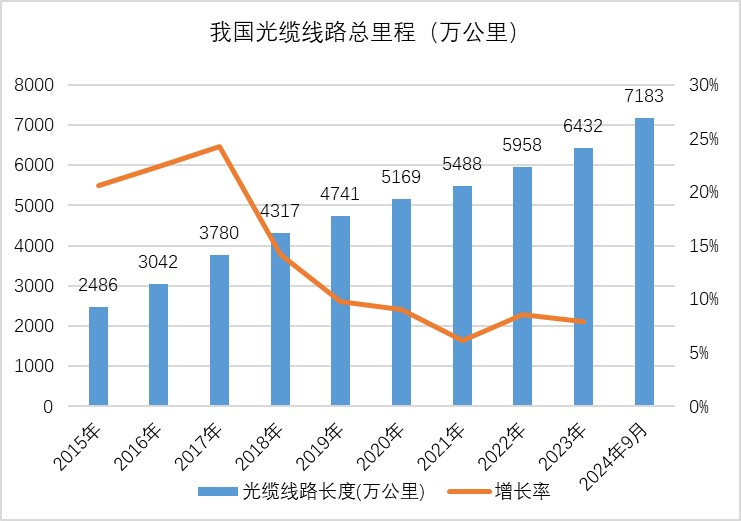
Optical fiber communication networks serve as the "foundation" for new infrastructure such as 5G, data centers, computing networks, and the Internet of Things, connecting "computing power" and "data." As of the third quarter of 2024, the total length of optical cable lines in my country reached 71.83 million kilometers, continuing its steady growth trend (as shown in Figure 1). With the gradual expansion of the commercial scale of 400G optical transmission systems in my country, the deployment of G.654.E optical fiber in trunk lines has significantly accelerated, making it the preferred choice for applications adaptable to ultra-high-speed long-distance optical transmission of 400Gbit/s and above. Against the backdrop of the continued rapid growth of global data traffic, optical fiber communication networks face higher performance requirements in terms of capacity, distance, and latency, and new optical fibers have become a necessity for building higher-quality optical fiber communication networks.
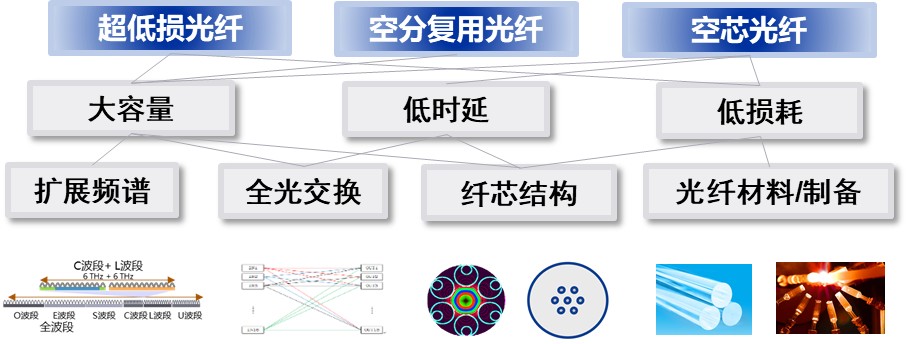
From the perspective of new optical fiber technology development, ultra-low loss fiber, space-division multiplexing fiber, and hollow-core fiber are the three key directions (as shown in Figure 2), which can help improve the performance of optical fiber communication networks. Among them, ultra-low loss fiber is currently key to improving the transmission performance of optical networks, adaptable to ultra-high-speed, long-distance, multi-band, and large-capacity transmission systems of 400 Gbit/s and above per wave, providing excellent all-optical interconnect performance. Space-division multiplexing fiber technology, mainly based on "multi-core, few-mode," can double the transmission capacity of a single fiber, thus becoming an important candidate technology for increasing transmission capacity to the terabit level in the future. Hollow-core fiber possesses intrinsic advantages such as ultra-large bandwidth, ultra-low latency, ultra-low transmission loss, and ultra-low nonlinearity. In particular, it has demonstrated performance advantages that break through the bottlenecks of traditional solid-core fiber technology, possessing enormous potential to reshape the development paradigm of the optical communication industry.
Current Status and Challenges of New Optical Fiber Development
Ultra-low loss fiber has entered the stage of large-scale commercial use; my country should accelerate its deployment.
Currently, ultra-low loss fiber technology is maturing and is helping optical transmission systems move towards ultra-high speed, large capacity, and long distance.
In terms of backbone network applications in my country, G.652.D fiber holds an absolute advantage in quantity, accounting for over 95%. It supports single-wavelength transmission speeds of 400 Gbit/s and higher, "C+L" and wider band transmission, demonstrating superior performance in ultra-long-distance, high-capacity transmission, and is continuously being optimized for lower loss. Currently, the fabrication technology of G.654.E fiber is mature; its large effective area core not only gives it lower nonlinear characteristics but also significantly reduces transmission loss.
From the perspective of industry chain development, well-known domestic and international companies such as Yangtze Optical Fibre and Cable, Hengtong Optic-Electric, Fiberhome Telecommunication Technologies, and Zhongtian Technology in China, as well as Corning Incorporated in the United States and Sumitomo Electric Industries in Japan, have launched commercial ultra-low loss optical fiber products. my country's three major telecom operators have all initiated large-scale procurement and deployment. In 2023, my country's deployed G.654.E new ultra-low loss optical fiber cable (including G.652.D and G.654.E hybrid cables) exceeded 35,000 km in length, and its deployment scale continued to expand in 2024. This cable is also being used in dedicated networks for industries such as power and railways.
It is foreseeable that in the coming years, as optical cables in the "eight horizontal and eight vertical" backbone network gradually reach their retirement age, my country's optical fiber communication network will accelerate the large-scale deployment of G.654.E and other new ultra-low loss optical fibers in the national backbone network, inter-provincial backbone network, and intra-provincial backbone network. This will meet the application requirements of ultra-large capacity optical transmission systems with single-wavelength speeds of 400 Gbit/s, 800 Gbit/s, and higher, providing strong support for the formation of new productive forces in the information and communication field and the high-quality development of computing networks.
Applications of Space Division Multiplexing (SDM) Fiber Optics Simultaneously Explored in Terrestrial and Submarine Cables
Due to the intrinsic characteristics of traditional optical fibers, the capacity of single-mode fiber is limited to the 100 Tbit/s range. To overcome this capacity bottleneck, research institutions both domestically and internationally have shifted their focus to next-generation fiber optic communication technologies based on SDM fiber.
From a technological development perspective, my country's research level in the field of SDM fiber and its systems is currently roughly in sync with international standards. However, given the immaturity of key technologies and devices, large-scale commercialization is not yet feasible. In the future, further investment in research and development from industry, academia, research institutions, and users is needed to strive for key breakthroughs.
In terms of international research and application, in 2024, Google collaborated with NEC Corporation of Japan to deploy the TPU submarine cable system using multi-core fiber technology, which is expected to be completed and operational by the end of 2025. In the same year, at the European Conference on Optical Communications (ECOC), the National Institute of Information and Communications Technology (NICT) of Japan announced its achievement of an optical transmission system with a capacity of 22.9 Pbit/s based on 38-core trimode optical fiber. Furthermore, in 2024, Japanese telecom operator NTT, in collaboration with NEC, conducted a 7280km transoceanic transmission test using 12-core optical fiber.
In terms of domestic research and application, in 2023, China Information and Communication Technologies Group (CICT) built an optical transmission system with a total transmission capacity of 4.1 Pbit/s using 19-core single-mode multi-core optical fiber. In 2024, Yangtze Optical Fibre and Cable (YOFC), in conjunction with China Mobile, successfully piloted a multi-core optical fiber solution for data centers. In the same year, Hengtong Optic-Electric Co., Ltd. conducted research on 38-core distributed sensing and high-capacity communication co-fiber transmission technology.
From the perspective of overall industry progress, multi-core space-division multiplexing optical fiber will first be applied in submarine cable optical communication and data center interconnection scenarios, thereby promoting commercial applications.
Hollow-core optical fiber is poised to become a disruptive enabling technology for the development of the optical communication industry.
From the perspectives of key transmission performance indicators such as transmission capacity, bandwidth, delay, nonlinear effects, and dispersion, hollow-core optical fiber outperforms traditional solid-core optical fiber. In the future, hollow-core optical fiber is expected to trigger disruptive technological innovations in fields such as optical fiber cables, optical devices, and optical communication systems, driving the development of entirely new application scenarios. my country should seize this opportunity for technological innovation, accelerate its technological breakthroughs, and strive to gain a leading edge in the field of hollow-core optical fiber technology.
Among hollow-core optical fiber structures, the performance advantages of the anti-resonant structure are particularly significant. This structure was proposed in 2002 by a team from the University of Bath in the UK. Since then, research institutions and enterprises, represented by the University of Bath, the University of Southampton, and Microsoft, have actively participated in the research and development and application promotion of hollow-core optical fiber technology, accumulating certain technological and industrial first-mover advantages. At the 49th Optical Networks and Communications Symposium and Expo, they announced their technological achievement of achieving a fiber transmission loss of less than 0.11 dB/km in the 1550nm band, successfully breaking through the traditional fiber loss limit of 0.14 dB/km.
For many years, Chinese universities, research institutes, fiber optic cable companies, and operators have been conducting research on hollow-core fiber technologies. Based on reported research progress, my country's overall technological research level is in sync with international standards, and multi-dimensional application explorations have been carried out in live network trials. However, overall, the manufacturing processes of hollow-core fiber cables and the overall technological maturity of optical transmission systems still need further improvement. Many problems remain in key indicators and live network applications, urgently requiring verification and breakthroughs through testing.
Hollow-core fiber has the potential to disrupt the optical communication ecosystem and is in a crucial window of opportunity for development in terms of technological research, related industrial resource investment, and applications. Therefore, industry competition is fierce. my country needs to further consolidate its industrial strength, increase investment in technological research and development and industrial layout, accelerate the improvement of technological maturity in areas such as optical fiber and cable manufacturing, optical module devices, and optical transmission systems, gradually form my country's technological advantages in these fields, and consolidate my country's leading position in the global optical fiber and cable and optical communication industries.
Progress in International and Domestic Standardization of New Optical Fibers
Currently, international standards for optical fibers and cables have been systematically constructed, and my country's standardization efforts are generally in sync with international standards. The development of international standards for optical fibers and cables is mainly undertaken by Study Group 5 of Study Group 15 of the Telecommunication Standardization Sector of the International Telecommunication Union (ITU-T) and Working Group 86 of the International Electrotechnical Commission (IEC). The current standard system is relatively complete. The latest research cycle mainly focuses on space-division multiplexing optical fibers and hybrid optoelectronic cables, with active participation from relevant organizations in the EU, the US, Japan, and China. Domestically, Working Groups WG1, WG3, and WG4 of the China Communications Standards Association Transmission and Access Network Technology Working Committee (CCSA TC6) have published a series of standards for optical fibers, cables, devices, and transmission systems in the communications industry. In the fields of new optical fibers such as space-division multiplexing fiber and hollow-core fiber, the working group has initiated and carried out several research projects, and will continue to gradually advance the initiation and research of relevant standards for new optical fibers.
In promoting the international standardization of new optical fibers, my country should also consolidate industrial efforts and coordinate work in the following aspects:
In the field of ultra-low-loss optical fibers, ITU-T's G.652 and G.654 standards have been published for many years. Currently, for long-distance applications with single-wavelength rates of 800 Gbit/s and above, there is a demand for a wider available spectrum than "C6T+L6T," as well as a demand for lower cutoff wavelengths. Simultaneously, further research is needed on the key parameters of new ultra-low-loss, large effective area single-mode optical fibers, and the development of relevant standards is required to form a unified international standard.
In the field of space-division multiplexing optical fiber, the ITU-T SG15 meeting in December 2023 initiated the G.sup.G.65x project, launching the research and development of space-division multiplexing optical fiber standards. The aim is to determine the types, expected application areas, technical framework, and roadmap for space-division multiplexing optical fibers. Simultaneously, in the field of submarine cable standards, priority is given to research related to "multi-core few-mode" fibers, particularly the research and development of standards for 2-core and 4-core single-mode fibers. my country should seize this opportunity for standardization and continue to contribute to international standard-setting.
In the field of hollow-core optical fiber, although ITU-T's international standardization research has not yet started, relevant proposals are already under discussion. Domestically, CCSA TC6 has initiated a research project and is comprehensively conducting technical research on optical fibers, devices, and systems. After unifying domestic technical requirements, it will also collaboratively promote the development of international standards. It is foreseeable that hollow-core optical fiber will become a hot topic in the research of new optical fiber international standards in the future.
To meet emerging demands such as computing power and interconnectivity, the fiber optic cable industry will be in a critical period of accelerated research and deployment of new fiber optic technologies in the coming years, with global demand for fiber optic cables showing a continuous growth trend. Currently, my country accounts for approximately 50% of both global demand and supply in the fiber optic cable market. However, in terms of research and application exploration of new fiber optic technologies, China is still in a follower or parallel development stage. Furthermore, while my country's fiber optic cable industry chain is basically complete, there are shortcomings in specific raw materials, and the industrial structure needs further optimization and adjustment.
In the future, my country should seize the important innovation opportunities presented by the development of new fiber optic technologies such as hollow-core fiber, continuously consolidate its industrial advantages, and promote the integrated development of core technologies such as ultra-low-loss fiber, multi-core fiber, and hollow-core fiber, as well as corresponding modules, devices, equipment, and systems. Accelerating application pilots and large-scale deployment will enhance the core competitiveness of my country's next-generation fiber optic communication technology and optical networks, accelerate the cultivation of new productive forces, and solidify the foundation for my country's network power.